The Tsum Valley, in the Manaslu region of northern Gorkha near the Tibetan border, is a remote Himalayan valley known for its traditional villages, mountain scenery and strong Tibetan Buddhist heritage. The trek follows peaceful trails through forests, stone settlements and ancient monasteries, offering an authentic experience of the valley’s distinctive landscape and local way of life.

Tsum Valley Trek - 11 Days
Trip Facts
Duration
11 Days
Trip Grade
Moderate
Country
Nepal
Maximum Altitude
3,700 m (Mu Gompa)
Starts
Kathmandu
Ends
Kathmandu
Group Size
1 to 20
Activities
Trekking
Best Time
March–May & September–November
Key Highlights of Tsum Valley Trek
- Explore the remote Tsum Valley in northern Gorkha, away from Nepal’s busier trekking routes.
- Experience the Tsumba people’s Tibetan Buddhist culture, traditions and village life.
- Learn about the Shyagya tradition of non-violence, an important part of Tsum’s cultural heritage.
- Trek through traditional villages including Lokpa, Chumling, Gho, Chhekamparo, Lama Gaon, Nile and Chhule.
- Visit important cultural sites including Rachen Gompa, Burji and Piren Phu (Milarepa’s Cave).
- See mani walls, chortens, prayer flags and Buddhist monasteries throughout the valley.
- Reach Mu Gompa, an important Tibetan Buddhist monastery in the upper Tsum Valley.
- Visit Dephyudonma Nunnery, one of the remote Buddhist sites in the upper valley.
- Experience changing Himalayan landscapes, from forested trails and terraced hillsides to open mountain terrain and river valleys.
- Cross suspension bridges and rugged trails along the Budhi Gandaki and Tsum valleys.
Tsum Valley Trek Overview
The Tsum Valley Trek – 11 Days is a moderate to challenging trek in the Manaslu region of north-central Nepal, taking you into the remote Tsum Valley of northern Gorkha district. The route combines mountain scenery, traditional villages, forested trails, terraced hillsides and a distinctive Tibetan Buddhist heritage. Compared with Nepal’s busier trekking routes, Tsum Valley offers a quieter mountain experience, with stone houses, mani walls, chortens, prayer flags and Buddhist monasteries along the trail. Mu Gompa at approximately 3,700 m (12,139 ft) is the highest overnight point of the trek.
The journey begins with a full-day drive from Kathmandu to Machha Khola, passing through Dhading, Gorkha, Arughat and Soti Khola before entering the Budhi Gandaki Valley. Trekking starts along the Budhi Gandaki River and continues through Jagat, Sirdibas and Philim, where the trail turns towards Lokpa and enters Tsum Valley. From Lokpa, the route follows increasingly remote and rugged terrain through Chumling, Gho, Chhekamparo and Lama Gaon, with forested slopes, cultivated land and traditional settlements becoming more prominent as you gain elevation.
At Lama Gaon, an acclimatisation and cultural exploration day provides time to visit Rachen Gompa, Burji and Piren Phu (Milarepa’s Cave) before continuing towards the upper valley. The trail then passes through Lar, Phurbe, Pangdun, Chhule and Nile to reach Mu Gompa, the highest overnight point and the furthest point of the trek. On the return through the upper valley, the route also includes Dephyudonma Nunnery. The landscape becomes more open and sparsely settled as you approach the upper valley, with fewer cultivated areas and more exposed mountain terrain.
The return journey follows the valley back through Chhekamparo, Gho, Dumje and Chumling, continuing via Gumlung and Lungwa Khola to Lokpa. From there, the trail retraces the route through Ekle Bhatti, Philim, Sirdibas and Jagat, where the trekking section ends. Local shared transportation connects Jagat with Machha Khola, followed by the return drive to Kathmandu the next day. Because road conditions, traffic and local construction can affect the transport sections, some flexibility is useful when travelling through this remote Himalayan region.
Why Choose Tsum Valley Trek?
The Tsum Valley Trek – 11 Days is suited to travellers looking for a quieter Himalayan trekking experience with a strong Tibetan Buddhist cultural character. The route combines traditional villages, forested trails, monasteries, cultivated hillsides and open mountain terrain as it gradually enters the remote upper valley.
The trek also gives you time to experience the valley beyond its main trail. An acclimatization and cultural exploration day at Lama Gaon allows visits to Rachen Gompa, Burji and Piren Phu, while the journey to Mu Gompa at 3,700 m (12,139 ft) takes you into the higher and more sparsely settled part of Tsum Valley.
➥ A Unique and Remote Himalayan Experience
Tsum Valley lies in northern Gorkha and remains a relatively quiet trekking destination compared with Nepal's more established routes. The trail leaves the main Manaslu route at Ekle Bhatti and enters the Tsum Valley through Lokpa, continuing through Chumling, Gho, Chhekamparo, Lama Gaon, Nile and Chhule.
For travellers who want to explore the Himalayas away from busier trekking corridors, Tsum Valley provides a different experience from the well-known Manaslu Circuit Trek. The trails are quieter and the settlements more remote, although trekking facilities remain basic, particularly as you approach the upper valley.
➥ Tibetan Buddhist Culture and Shyagya Tradition
The cultural character of Tsum Valley is one of the main reasons to visit. Traditional stone houses, mani walls, chortens, prayer flags and Buddhist monasteries appear throughout the route, while Tibetan Buddhist beliefs and practices remain closely connected with local community life.
The valley is also known for the Shyagya tradition of non-violence, which reflects local Buddhist values and includes restrictions on activities such as hunting, trapping and killing animals. For travellers interested in the cultural side of trekking, the journey provides opportunities to observe how religious traditions remain part of everyday life in the mountain communities.
➥ Sacred Sites and the Legacy of Saint Milarepa
The trek includes several important Buddhist sites, including Rachen Gompa, Piren Phu and Mu Gompa. At Lama Gaon, you have time to explore Rachen Gompa and continue towards Piren Phu (Milarepa's Cave) before returning to the teahouse for the night.
Piren Phu is traditionally associated with Saint Milarepa, the renowned Tibetan Buddhist yogi and poet. Local Buddhist tradition connects the cave with his meditation and spiritual practice, and the site contains shrines, religious images and traditional murals that add an important cultural element to the trek.
➥ Traditional Villages and Mountain Life
The Tsum Valley Trek route passes through traditional settlements such as Lokpa, Chumling, Gho, Chhekamparo, Lama Gaon and Nile, allowing you to see different aspects of village life as the trail moves higher into the valley. Agriculture, livestock, tourism and other forms of employment contribute to local livelihoods, while traditional architecture and Buddhist cultural practices remain visible along the route.
Accommodation and food are also part of the experience. The trek uses teahouses, where facilities are simple and become more limited in the higher settlements. Local meals are generally based on staple foods such as rice, wheat, barley and potatoes, while travellers may also encounter traditional Tibetan-style drinks and foods during their stay.
➥ Mountain Scenery and Changing Landscapes
The landscape changes steadily throughout the journey. The lower stages follow the Budhi Gandaki River through forests, terraced hillsides and narrow valleys, while the trail inside Tsum Valley becomes more rugged and increasingly open as it approaches Chhule, Nile and Mu Gompa.
Suspension bridges, river valleys, forested slopes, cultivated land and high mountain terrain create a varied trekking environment. The combination of quieter trails, Himalayan scenery and a distinctive Buddhist culture makes Tsum Valley a natural choice for travellers interested in a crowd-free escape trekking experience in Nepal.
Benefits of Trekking with Himalayan Ecological Trekking on the Tsum Valley Trek
- Airport Pick-up and Drop-off: Complimentary private airport transfers are provided at the start and end of your trip, making your arrival and departure easier to manage.
- Experienced Local Guides: Our trekking leaders have extensive knowledge of Nepal's mountain trails and local communities. Many have grown up in trekking regions and can provide practical guidance and insight into local culture and daily life.
- Online Trip Briefing: Before departure, we provide an online briefing covering your itinerary, packing requirements, trekking conditions and other practical details to help you prepare properly.
- Fixed Departure Guarantee: We operate the trek on the confirmed departure date, providing greater certainty when planning your travel.
- Easy Communication: You can contact our team through Email, WhatsApp, Instagram, Facebook, Viber, Telegram or Zoom before and during your trip.
- 24/7 Support: Our support team is available throughout your trek to assist with questions, communication and unexpected situations. You can contact us anytime via WhatsApp at +9779851006023.
- Convenient Payment Options: We provide a straightforward and secure payment process for booking and arranging your trek.
- Free Luggage Storage: Excess luggage can be stored at our Kathmandu office while you are trekking, allowing you to carry only what you need on the trail.
- Waterproof Duffle Bag for Porters: When you hire porter service, we provide a waterproof branded duffle bag for your trekking gear. The bag can also be kept as a souvenir after the trek.
- Suitable for Solo Trekkers and Groups: The Tsum Valley Trek can be arranged for solo travelers, couples, families and groups. Solo trekkers can also choose a private trekking arrangement with a guide.
Tsum Valley Trek - 11 Days Itinerary
Day 1
Drive to Machha Khola (8–9 hrs, 160 km, 930m)
Max Altitude: 930m (3,051ft)
Meals: Lunch and Dinner
Accommodation: Teahouse
Our journey to Machha Khola begins early in the morning after breakfast. We set off on a scenic drive westward from Kathmandu, following the Prithvi Highway alongside the Trishuli River. After a couple of hours, we cross the Trishuli River at Malekhu and leave the main highway behind. From here, a one-hour drive brings us to Dhading Besi, the largest town in Dhading District, offering the first glimpses of the Ganesh Himal region.
Beyond Dhading Besi, we ascend through Murali Bhanjyang and Palpa Bhanjyang, where breathtaking views of Ganesh Himal to the north and Himal Chuli to the west unfold. The road then descends from Golbhanjyang to Tari Besi before crossing the Ankhu Khola bridge into Salyantar, one of Dhading’s largest flatlands.
When we reach Arughat, we transition from paved roads to a more rugged path—hold on to your hats! The drive continues along the Budhi Gandaki River, passing through Soti Khola before finally arriving at Machha Khola. Depending on your preference, we can either take a local bus or a private jeep. The journey takes approximately 8-9 hours, and road conditions vary from smooth highways to bumpy, dusty trails, especially beyond Arughat.
Upon arrival in Machha Khola, we check in for the night, resting for the trek ahead.
Day 2
Trek to Jagat (6–7 hrs, 22 km, 1,340m)
Max Altitude: 1,340m (4,396ft)
Meals: Breakfast, Lunch and Dinner
Accommodation: Teahouse
Today marks the first day of trekking as we follow the Budhi Gandaki River northward. The trail gradually ascends alongside the river, offering high overlooks and, on a clear day, glimpses of Manaslu. The route winds through terraced farms and small villages where locals have carved out a living on the mountainside.
The lower elevation here means a warmer climate, with temperatures reaching up to 33°C. As we trek, we pass Tatopani (meaning "hot water"), a natural hot spring, before reaching a suspension bridge. At this point, we have two options—either crossing to the east side of the Budhi Gandaki or continuing along the west, both leading to Jagat. For much of the journey, we follow the east side until another suspension bridge takes us back west.
Along the way, we stop in Dobhan for lunch before continuing on the ascending trail. The final stretch involves crossing the river once more before arriving at Jagat, a major village where we check in at the permit checkpoint. Jagat offers several guesthouses, making it a comfortable stop for the night.
Day 3
Trek to Lokpa (6–7 hrs, 16 km, 2,240m)
Max Altitude: 2,240m (7,349ft)
Meals: Breakfast, Lunch and Dinner
Accommodation: Teahouse
Today, we officially enter Tsum Valley. The journey begins with a long suspension bridge crossing over the Budhi Gandaki River, followed by a steady ascent to Philim. Along the way, we descend briefly into Sirdibas, where small streams power traditional grist mills. Beyond Sirdibas, we cross either of two final suspension bridges over the Budhi Gandaki, making our way up to Philim.
Philim is a large village with hotels, shops, and a school. It serves as an important checkpoint where we complete our permit registration. From here, settlements become sparse as we continue north. The trail clings to the mountainside, weaving up and down while offering spectacular views of cascading waterfalls that plunge into the deepening gorge of the Budhi Gandaki below.
We pass through the small villages of Eklebhatti and Chisapani (meaning "Cold Water"), where fresh spring water flows through community taps. As we move further north, houses disappear, and the river gradually narrows. Eventually, we reach the confluence of the Syar River, where Tsum Valley branches off to the right.
A final ascent brings us to Lokpa, the first village of Tsum Valley, offering stunning views of Manaslu. The trek takes approximately 6-8 hours, and while Lokpa is a small settlement, it provides adequate food and lodging for the night.
Day 4
Trek to Chumling (5–6 hrs, 14 km, 2,386m)
Max Altitude: 2,386m (7,828ft)
Meals: Breakfast, Lunch and Dinner
Accommodation: Teahouse
Lokpa may be the entrance to Tsum Valley, but the real entrance lies beyond the village in a deep narrow gorge. The trail from Lokpa drops down to the river valley and then up again before we reach the Cliffside suspension bridge. There are no villages between Lokpa and Chumling. There is a small tea shop at Gumlung where the trail divides. We cross the suspension bridge over the Syar River and ascend to the village of Chumling. Trekking time 5-6 hours.
Day 5
Trek to Lama Gaon (6–7 hrs, 12 km, 3,020m)
Max Altitude: 3,020m (9,908ft)
Meals: Breakfast, Lunch and Dinner
Accommodation: Teahouse
Today’s trek will go from the lower to the upper valley. The trail follows along the Syar River down to Domje and then rises over 500 meters to the largest village in Tsum Valley: Chhokang Paro. Of special interest is the pretty little village of Gho above Domje. There is also a tea shop and hotel. We advance further down the “highway” from Chhokang Paro through Tsum Valley.
Although the valley is narrow, it is fertile, and you can see the residents farming. Chhokang Paro is very typical Tibetan. We then reach Lamagon, a larger community in the Upper Tsum Valley.
Day 6
Exploration Day in Lama Gaon (Flexible, short hikes)
Max Altitude: 3,020m (9,908ft)
Meals: Breakfast, Lunch and Dinner
Accommodation: Teahouse
Lama Gaon offers a glimpse into the tranquil rhythm of life in Tsum Valley, where spirituality and nature exist in perfect harmony. The day begins with the soft glow of sunrise over Ganesh Himal, as villagers start their morning with prayers and simple routines. A warm breakfast of tsampa, buckwheat pancakes, and butter tea provides energy for the day’s exploration.
A visit to Rachen Nunnery and the new Tsum Monastery reveals a peaceful world where nuns chant ancient scriptures and vibrant murals depict Buddhist teachings. Walking through the village, mani walls and chortens line the trails, each stone etched with centuries-old prayers. Locals greet visitors warmly, sharing stories of their sacred valley.
Just a short hike past Lamagaon is Piren Phu or the cave of St. Milarepa. This revered meditation site is perched above the valley. The air is thick with spiritual energy, and the silence invites quiet reflection. The cave is located on the side of the mountain, and the cave monastery offers great views of the valley.
Returning to the village, a simple yet hearty meal of Thukpa or Dal Bhat offers a taste of their daily life. The afternoon may be spent wandering through barley fields and among stone houses, where children play and elders spin prayer wheels. As the sun sets, casting golden hues over the valley, the sound of evening chants fills the air, leaving a deep sense of peace and connection with this hidden Himalayan sanctuary.
Day 7
Trek to Mu Gompa (6–7 hrs, 16 km, 3,700m)
Max Altitude: 3,700m (12,139ft)
Meals: Breakfast, Lunch and Dinner
Accommodation: Monastery
Leaving Lama Gaon, the trail gently ascends through the valley, passing traditional Tsumba villages, mani walls, and chortens adorned with prayer flags fluttering in the mountain breeze. Along the way, the villages of Nile and Chule offer a glimpse into the unique culture of the Tsum Valley, with their traditional stone houses and welcoming locals.
As the path winds further north, the landscape becomes more rugged and remote, with panoramic views of the Ganesh Himal and the Tibetan plateau stretching in the distance. The spiritual presence of the valley deepens as you approach Mu Gompa, the northernmost point of the trek.
Perched on a hillside, Mu Gompa is a centuries-old monastery and an important Buddhist retreat. The monastery houses a small community of monks who dedicate their lives to meditation and study. Visitors are welcomed into the monastery’s simple yet serene atmosphere, where ancient scriptures, prayer wheels, and butter lamps add to its timeless charm.
Spending the night at Mu Gompa allows you to experience the monastic way of life: listening to evening prayers, enjoying a warm meal prepared by the monks, and soaking in the profound tranquility of this sacred place, far removed from the modern world.
Day 8
Trek to Chhekamparo (5–6 hrs, 14 km, 3,010m)
Max Altitude: 3,010m (9,875ft)
Meals: Breakfast, Lunch and Dinner
Accommodation: Teahouse
The morning at Mu Gompa begins in peaceful solitude, with the rhythmic chanting of monks filling the crisp mountain air. Before starting the descent, a short visit to the Dephyudonma Nunnery, located near Mu Gompa, offers a glimpse into the life of the Buddhist nuns who have dedicated themselves to meditation and spiritual practice in this remote setting. The nunnery, nestled against the stark Himalayan landscape, holds deep spiritual significance and provides a quiet moment for reflection before the journey south.
Retracing the trail, the trek gradually descends through Nile and Chule, passing familiar mani walls, chortens, and stone houses that dot the valley. The descent offers a different perspective of the surrounding peaks and landscapes, with occasional stops to soak in the vastness of Ganesh Himal and the rugged terrain stretching toward Tibet.
Continuing past Lama Gaon, the route leads back to Chhekamparo. The valley widens, revealing terraced fields and a cluster of traditional homes. After a long yet rewarding day, a warm meal and rest at a local teahouse, surrounded by the tranquil beauty of Tsum Valley, provide a comforting end to the journey.
Day 9
Trek to Ripchet (5–6 hrs, 12 km, 2,470m)
Max Altitude: 2,470m (8,103ft)
Meals: Breakfast, Lunch and Dinner
Accommodation: Teahouse
The morning in Chhekamparo begins with the sun casting its first light over the valley, illuminating the stone houses and terraced fields. After a warm breakfast, the journey continues south, leaving behind the upper Tsum Valley. The trail descends gradually, offering changing perspectives of the landscape as you pass familiar mani walls, prayer wheels, and scattered chortens.
The path to Ripchet leads through quiet forests, where the sounds of birds and rustling leaves replace the chants of monasteries. In sections, the route becomes more rugged, with occasional glimpses of waterfalls cascading down the cliffs. As you near Ripchet, the village appears nestled among lush greenery, offering a stark contrast to the high-altitude terrain of the past few days. This small, traditional settlement is home to warm-hearted locals, and spending the night here provides a closer look at their way of life.
Evening in Ripchet is peaceful, with the sounds of the Budhi Gandaki River flowing in the distance. A simple meal, shared with fellow trekkers or hosts, rounds off the day before resting in a cosy teahouse.
Day 10
Trek to Jagat (6–7 hrs, 16 km, 1,340m)
Max Altitude: 1,340m (4,396ft)
Meals: Breakfast, Lunch and Dinner
Accommodation: Teahouse
The trail continues its descent, moving away from the isolated beauty of Tsum Valley and reconnecting with the main Manaslu Circuit route. The walk from Ripchet to Jagat winds through forests of pine and rhododendrons, crossing suspension bridges over glacial rivers. The landscape transforms as the rugged highlands give way to fertile hillsides, where farmers tend to their terraced fields.
Along the way, small settlements offer moments to pause and take in the surroundings. The familiarity of the path brings a sense of reflection—passing places seen earlier in the trek, now from a different perspective. Approaching Jagat, the village feels more bustling compared to the quiet trails of the past days. Settled along the Budhi Gandaki River, Jagat offers a comfortable place to unwind, with teahouses providing warm meals and a restful atmosphere.
As the day winds down, a final glimpse at the mountain ridges above brings a mix of nostalgia and accomplishment, knowing the trek is nearing its end.
Day 11
Trek to Machha Khola (5–6 hrs, 22 km, 930m)
Max Altitude: 930m (3,051ft)
Meals: Breakfast, Lunch and Dinner
Accommodation: Teahouse
The journey continues through familiar terrain, retracing the trail that once led into the mystical Tsum Valley. Descending further, the route follows the Budhi Gandaki River, crossing suspension bridges and passing through subtropical forests. The warmer climate becomes more noticeable, and the vegetation grows denser, with occasional waterfalls cascading from the hillsides.
Villages along the way bustle with daily life—mules carrying supplies, children playing near the trails, and locals tending to their crops. The return trek feels lighter, with a sense of ease as the altitude drops and the paths become less steep. Machha Khola, a small riverside village, welcomes travellers with its comforting atmosphere. A soak in the nearby hot springs (if time permits) provides a well-earned reward after days of trekking in the remote valleys.
As the last night on the trail approaches, a hearty meal and the company of fellow trekkers make for a perfect end to the trekking journey.
Day 12
Drive to Kathmandu (8–9 hrs, 160 km, 1,400m)
Max Altitude: 1,375m (4,511ft)
Meals: Breakfast and Lunch
The morning starts with the final stretch—boarding a jeep back to Kathmandu, marking the transition from the quiet mountain trails back to the city’s energy. The drive, though long and bumpy in sections, retraces the route along the Budhi Gandaki River, passing through terraced fields, small villages, and winding mountain roads.
As Kathmandu comes into view, the contrast between the remote Himalayas and the bustling streets becomes more evident. The familiar sights and sounds of Thamel signal the end of an unforgettable journey. After checking into a hotel, a hot shower and a celebratory meal await—perhaps a well-deserved feast of Nepali dal bhat or something from the city’s many international eateries.
The trek may be over, but the memories of Tsum Valley—its sacred monasteries, kind-hearted locals, and breathtaking landscapes—will stay long after the journey ends.
Are you still confuse from where to start? We have solutions for you.
No worries — team is ready to guide you everystep of the way.
Tsum Valley Trek - 11 Days Route Map
Download Route Map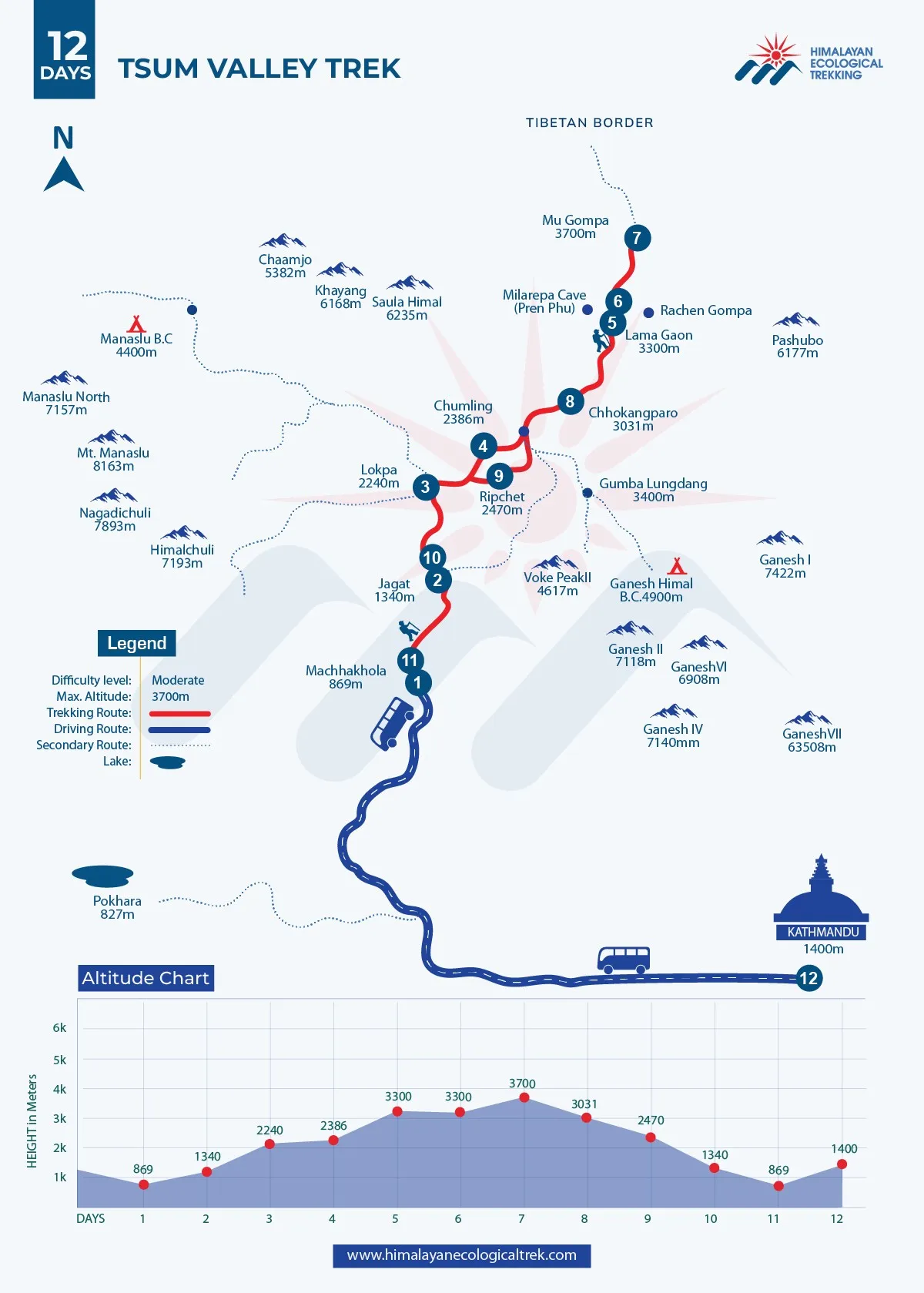
Altitude Chart
Cost Details
Includes
Transportation
- Complimentary airport pick-up and drop-off in Kathmandu by private vehicle.
- Road transportation from Kathmandu to Machha Khola at the beginning of the trek.
- Local shared transportation from Jagat to Machha Khola at the end of the trekking section.
- Road transportation from Machha Khola to Kathmandu at the end of the trip.
Accommodation
- 10 nights of accommodation in local teahouses during the trek.
- Standard twin-sharing rooms are provided at trekking teahouses.
- Rooms with attached bathrooms are offered where possible, while shared bathroom facilities are common, particularly at higher elevations.
- Teahouse facilities become more basic in the remote sections of Tsum Valley.
Meals & Drinking Water
- 10 breakfasts, 10 lunches and 10 dinners as specified in the itinerary.
- Full-board meals during the scheduled trekking days.
- Freshly prepared meals from available local teahouse menus.
- Safe drinking water support through water purification tablets.
Permits & Entry Fees
- Tsum Valley Restricted Area Trekking Permit.
- Manaslu Conservation Area Permit (MCAP).
- All required local permits and entry fees for the trek.
Guide & Support Staff
- Experienced, government-licensed English-speaking trekking guide with first-aid training and high-altitude trekking experience.
- One assistant guide for groups of more than 10 trekkers.
- Guide and support staff wages, meals, accommodation, transport and required trekking equipment.
Medical & Safety
- First-aid kit carried by the trekking guide.
- Pulse oximeter for basic pulse and oxygen-saturation checks.
- Basic altitude and health monitoring throughout the trek.
- Guidance on acclimatization and recognizing symptoms of altitude illness.
- Emergency assistance and coordination in case of illness or injury.
- Emergency evacuation coordination when required; rescue and evacuation costs should be covered by your travel insurance.
Trek Equipment & Services
- Company duffle bag for use during the trek.
- Warm sleeping bag provided for the trek and returned after completion.
- Trek Completion Certificate.
- Free online trip briefing and pre-booking consultation with Bikesh Rana, Founder and Managing Director of Himalayan Ecological Trekking.
- Pre-trek support in Kathmandu with practical guidance on the route, trekking conditions, equipment and final preparations.
- Assistance with final trek preparations and any last-minute arrangements before departure.
Excludes
International Travel & Visa
- International flights to and from Nepal.
- Nepal tourist visa fees and visa extension charges.
- Other immigration or entry-related fees.
Travel Insurance (Mandatory)
- Personal travel and medical insurance.
- Insurance for high-altitude trekking up to the maximum elevation of the trek.
- Emergency medical treatment, rescue, evacuation and repatriation costs.
Accommodation & Meals
- Accommodation and meals in Kathmandu outside the scheduled itinerary.
- Additional accommodation or meals required before or after the scheduled itinerary.
- Additional accommodation, meals or transport resulting from delays, illness, early return or other unforeseen circumstances.
Personal Expenses
- Personal trekking clothing and equipment.
- Personal toiletries and hygiene products.
- Bottled or additional drinking water.
- Tea, coffee, soft drinks and other personal beverages.
- Hot showers and laundry services.
- Wi-Fi, internet access and device charging.
- SIM cards, mobile data and international calls.
- Snacks, souvenirs, gifts and other personal purchases.
Porter Service, Transport & Additional Charges
- Porter service unless specifically included in your booking.
- Private or additional transportation outside the scheduled itinerary.
- Extra transport or related costs caused by personal itinerary changes, road delays, closures or other circumstances outside the company's control.
Medical & Emergency Costs
- Medical consultations, medicines and hospital treatment.
- Personal medical expenses not covered by your travel insurance.
- Emergency rescue, evacuation or repatriation costs not covered by your travel insurance.
Tips & Other Costs
- Tips for guides, porters, drivers and other support staff.
- Private-room supplements.
- Bank, card or money-transfer charges.
- Any new government fees, taxes or permit charges introduced after booking.
- Any service, activity or expense not specifically listed under “What's Included”.
Private Trip
Add-ons
Himalayan Ecological Trekking has been organizing trekking adventures for travelers in Nepal since 1995. We can arrange additional services for travelers who need extra luggage support, private transportation, accommodation in Kathmandu or more time on the trail.
The following optional services are available for the Tsum Valley Trek – 11 Days. All add-ons are subject to availability and additional charges.
Porter Service
A porter can be added if you prefer to trek with less weight. The porter carries your main trekking bag between overnight stops, while you carry a small daypack with essentials such as water, snacks, a warm layer, valuables and travel documents.
One porter is provided for every two trekkers and can carry up to 20 kg of combined luggage, with a maximum of 10 kg per trekker. Porter service is not included in the standard package and can be arranged at an additional charge.
Private Transport
The standard itinerary includes road transportation between Kathmandu and Machha Khola. Travelers who prefer a private vehicle can upgrade to a dedicated Scorpio or similar 4WD for both journeys.
Private transport is available for:
- Kathmandu to Machha Khola
- Machha Khola to Kathmandu
A private vehicle can accommodate up to 6 passengers, with capacity for up to 7 passengers depending on luggage, vehicle space and road conditions.
This option provides greater privacy and flexibility and is suitable for families, private groups and travellers who prefer to travel without sharing the road journey with other passengers.
Private Jagat–Machha Khola Transfer
The standard itinerary includes local shared transportation from Jagat to Machha Khola after completing the trekking section.
Travelers who prefer more privacy can upgrade to a dedicated private jeep for the Jagat–Machha Khola transfer instead of travelling by shared vehicle.
This is an optional transfer and is separate from the private road transportation between Kathmandu and Machha Khola included in the itinerary. It allows you to continue from Jagat in a private vehicle immediately after finishing the trek.
Additional charges apply, and the type of vehicle may vary depending on road conditions and group size.
Accommodation in Kathmandu
Accommodation in Kathmandu is not included in the standard package unless stated otherwise. We can arrange a hotel before or after the trek based on your preferred location, comfort level and budget.
Accommodation can be arranged on a room-only or bed and breakfast (BB) basis.
Extra Nights
Additional nights can be arranged in Kathmandu or at suitable locations along the trekking route.
An extra night in Kathmandu can be useful before the trek for rest and preparation after your international flight, or after the trek if your international departure is later.
Extra trekking nights can also be added for a slower pace, shorter walking days, additional rest or more time in the traditional villages and cultural areas of Tsum Valley. The itinerary, accommodation and meals will be adjusted accordingly.
Trekking Equipment Rental
Selected trekking equipment can be rented before the trek, including sleeping bags, trekking poles, warm jackets and other suitable trekking gear.
Warm clothing and a suitable sleeping bag are particularly useful for the higher sections of the route, including Mu Gompa at approximately 3,700 m (12,139 ft), where overnight conditions can be cold.
Trek Extension and Extra Walking Days
The Tsum Valley Trek – 11 Days can be extended for travelers who want more time in the mountains.
Additional days can be used to reduce walking hours, allow more rest, spend longer in villages, add cultural visits or explore other suitable areas of Tsum Valley and the wider Manaslu region.
A revised itinerary can be prepared based on your preferred walking pace, travel dates and available time.
Note: Optional services are not included in the standard package unless specifically mentioned. All add-ons are subject to availability and additional charges. Please let us know your requirements when booking so that we can confirm the arrangements and applicable costs in advance.
Equipment Lists for Tsum Valley Trek - 11 Days
The Tsum Valley Trek – 11 Days reaches approximately 3,700 m (12,139 ft) at Mu Gompa and includes forest trails, rocky sections, suspension bridges, village paths and more exposed terrain in the upper valley. Pack for changing weather and temperatures, with warm clothing for higher elevations while keeping your trekking gear practical and manageable for teahouse stays. A good layering system, comfortable trekking boots, rain protection and basic personal supplies are especially useful on this remote route.
Head & Face
- Sun hat or trekking hat
- Warm wool or fleece hat
- Buff or neck gaiter
- UV-protection sunglasses
- Sunglasses case
- SPF 30–50+ sunscreen
- Lip balm with SPF
- Lightweight face covering for cold, wind or dust
Upper Body
- Quick-drying trekking T-shirts
- Long-sleeved trekking shirt
- Moisture-wicking or thermal base layer
- Fleece or warm mid-layer
- Down or insulated jacket
- Waterproof and windproof jacket
- Sports bra for women
Hands & Feet
- Lightweight liner gloves
- Warm insulated gloves
- Well-broken-in trekking boots with good grip and ankle support
- Comfortable trekking socks
- Warm socks for higher elevations
- Spare pairs of trekking socks
- Lightweight camp shoes or sandals
- Gaiters, optional for wet, muddy or snowy conditions
Lower Body
- Quick-drying trekking trousers
- Trekking shorts
- Thermal leggings or base layer
- Warm or insulated trekking trousers
- Waterproof overtrousers
- Comfortable quick-drying underwear
Sleeping & Trekking Gear
- Warm sleeping bag (provided by the company)
- Waterproof duffle bag (provided by the company)
- Sleeping-bag liner, optional
- Daypack (25–35 liters) with rain cover
- Lightweight, collapsible trekking poles
- Reusable water bottles or hydration bladder (2–3 liter capacity)
- Insulated water bottle or thermos, optional
- Waterproof or dry bags for clothing, valuables and documents
- Small padlock
- Earplugs, optional
Documents & Money
- Passport
- Nepal visa or required visa documents
- Travel insurance details
- Copies of required permits and booking documents
- Copies of important travel documents
- Emergency contact details
- Nepalese Rupees in cash
- Credit or debit card
First Aid & Medication
- First-aid kit and pulse oximeter (provided by the company)
- Personal prescription medication
- Blister treatment
- Plasters and adhesive bandages
- Medical tape
- Antiseptic wipes
- Pain-relief medication, if suitable for you
- Oral rehydration salts
- Cough drops or throat lozenges
- Any altitude medication, if prescribed
- Personal medical information and emergency contact details
Electronics & Accessories
- Smartphone or camera
- Headlamp with spare batteries
- Power bank
- Charging cables
- Universal travel adapter
- Spare batteries, if required
- Offline GPS or map app
- Camera accessories, optional
Optional Items
- Binoculars
- Extra snacks
- Book or e-reader
- Travel pillow
- Small notebook and pen
- Headphones or earbuds
Essential Information
Useful Information about the Tsum Valley Trek
The Tsum Valley Trek – 11 Days is a remote Himalayan trek in the northern Gorkha district of Nepal, within the Manaslu region and close to the Tibetan border. The route combines forested trails, terraced hillsides, traditional stone villages and a strong Tibetan Buddhist heritage associated with the Tsumba people. The trek follows the Budhi Gandaki Valley from Kathmandu to Machha Khola and Jagat, turns into Tsum Valley at Lokpa, and continues through Chumling, Lama Gaon and the upper valley to Mu Gompa at 3,700 m, before returning to Jagat and Machha Khola. Because the trek is away from Nepal's busier trekking corridors, the route offers a quieter mountain experience, with fewer trekkers and more opportunity to observe traditional village life and the valley's distinctive cultural landscape.
Before Your Tsum Valley Trek
A little preparation in Kathmandu will make the start of your Tsum Valley Trek – 11 Days easier and more organized. Before leaving for Machha Khola, make sure your travel documents, trekking equipment, personal essentials and baggage arrangements are ready. You will also have an opportunity to meet your trekking team, review the itinerary and complete any final arrangements before beginning the road journey.
What Should You Do Before Starting the Tsum Valley Trek?
Before leaving Kathmandu for Machha Khola, make sure you have all the essential items and documents ready for the trek. You should:
- Carry a valid passport and Nepal visa or other applicable entry documents.
- Keep your travel insurance policy and emergency assistance details accessible.
- Check your trekking boots, warm layers, rain protection and essential equipment before departure.
- Prepare a comfortable daypack for the items you will carry while walking.
- Keep your passport, permits, money, medication and other valuables secure.
- Make sure your main trekking baggage is packed within the agreed porter limit if you are using porter service.
- Inform us in advance about any dietary requirements, allergies or special arrangements.
- Complete any last-minute shopping, equipment rental or other preparations in Kathmandu.
- Get enough rest before the trek, particularly because the first day involves a long road journey.
- Keep important contact details on your phone and carry a backup copy where practical.
The trek eventually reaches Mu Gompa at 3,700 m, so appropriate warm clothing and reliable trekking footwear are important. Your itinerary also includes an acclimatisation and cultural exploration day at Lama Gaon, so you should be prepared for gradual elevation gain and longer days on uneven mountain trails.
Airport Pick-up and Hotel Transfer in Kathmandu for the Tsum Valley Trek
Himalayan Ecological Trekking provides complimentary airport pick-up and transfer to your hotel in Kathmandu by private vehicle. After arriving at Tribhuvan International Airport (TIA), our representative will meet you and transfer you to your hotel.
After checking in, you can rest from your international journey and begin your final preparations for the Tsum Valley Trek. You can also use this time to check your equipment, organize your baggage and complete any last-minute arrangements.
Kathmandu accommodation is not included in the standard trekking package unless specifically stated in your booking. When required, Himalayan Ecological Trekking can arrange suitable hotel accommodation based on your preferred location, comfort level and budget.
Note: Please provide your confirmed international flight details before arrival so we can arrange your airport pick-up. Inform us as soon as possible if your flight schedule changes.
Tsum Valley Trek Pre-Trek Briefing in Kathmandu
Himalayan Ecological Trekking arranges a pre-trek briefing in Kathmandu before you leave for Machha Khola. Your guide or HET representative will review the main arrangements for the trek and answer any final questions before departure.
The briefing is particularly useful for checking your equipment, confirming the walking schedule and making sure you understand the practical arrangements for the Tsum Valley Trek.
What Happens During the Pre-Trek Briefing for the Tsum Valley Trek?
The briefing covers:
- The final itinerary and daily walking schedule
- The route from Kathmandu to Machha Khola and the trekking route from Machha Khola into Tsum Valley
- Accommodation and meal arrangements
- Trekking permits and required documents
- Baggage arrangements and porter service, where applicable
- Recommended trekking gear, clothing and footwear
- General preparation for walking on uneven mountain trails
- The altitude gain towards Lama Gaon and Mu Gompa
- The purpose of the Lama Gaon acclimatization day
- Weather and trail conditions in general terms
- Your daypack and main luggage arrangements
- Any personal requirements or special arrangements
- Final questions before leaving Kathmandu
The briefing also gives you time to meet your guide, check your trekking equipment and clarify any questions about the itinerary before the trek begins.
Getting to and Returning from the Tsum Valley Trek
The Tsum Valley Trek begins and ends with road travel from Kathmandu. The trekking section starts at Machha Khola, continues to Jagat and then turns towards Tsum Valley at the trail junction near Ekle Bhatti. After completing the return trekking section, you travel from Jagat to Machha Khola by local shared transportation before taking the road back to Kathmandu the following day.
How Do You Get to the Tsum Valley Trek Starting Point?
The Tsum Valley Trek begins with a road journey from Kathmandu to Machha Khola, in the lower Budhi Gandaki Valley.
The route generally follows:
Kathmandu → Prithvi Highway → Dhading → Gorkha → Arughat → Soti Khola → Machha Khola
The road passes from the Kathmandu Valley into rural hill country, with changing views of terraced farmland, villages, forests and river valleys. As you travel beyond Soti Khola, the road becomes more rugged as it follows the Budhi Gandaki Valley towards Machha Khola.
What Is the Drive from Kathmandu to Machha Khola Like on the Tsum Valley Trek?
The journey is a long mountain road trip rather than a short transfer. The first part follows major roads before turning onto increasingly winding and uneven hill roads.
As the route approaches Machha Khola, the surroundings become more remote, with steep hills, river valleys, small settlements and sections of rougher road. The journey gives you a gradual transition from the busy Kathmandu Valley to the more isolated mountain environment where the trekking section begins.
How Long Does the Kathmandu to Machha Khola Journey Take for the Tsum Valley Trek?
The drive from Kathmandu to Machha Khola usually takes around 8–9 hours, although actual travel time can vary.
Traffic, road conditions, local construction, vehicle movement and stops along the way can all affect the duration. It is therefore better to treat the journey time as an approximate guide rather than a fixed travel schedule.
What Road Conditions Should You Expect on the Way to Machha Khola During the Tsum Valley Trek?
Road conditions vary considerably along the route. The main highway sections are generally easier, while the road beyond the larger settlements becomes narrower, rougher and more uneven in places.
You may encounter rocky sections, potholes, winding hill roads and slower-moving traffic as the road follows the Budhi Gandaki Valley. Local road construction can also change the condition of particular sections.
A flexible approach is useful because the actual journey may take longer than expected when road or traffic conditions are difficult.
How Do You Travel from Jagat to Machha Khola on the Tsum Valley Trek?
After completing the final trekking section, you reach Jagat, where the trekking portion of the journey ends. From there, the itinerary continues by local shared transportation, usually a shared jeep or local bus, to Machha Khola, depending on local transport arrangements.
The road section usually takes around 2–3 hours, although the journey may be slower when road conditions or local transport availability are less favorable. Shared vehicles are a practical way to connect the end of the trekking section with Machha Khola before the final drive to Kathmandu.
How Do You Return from Machha Khola to Kathmandu After the Tsum Valley Trek?
After breakfast in Machha Khola, you begin the return drive to Kathmandu. The road follows the Budhi Gandaki Valley through Soti Khola and Arughat, then continues towards Dhading Besi before joining the Prithvi Highway for the final part of the journey to Kathmandu.
The drive takes approximately 8–9 hours, although the actual travel time can vary depending on traffic, road conditions, road works and stops along the way. As much of the route passes through mountain roads, some flexibility is useful when planning your onward travel.
Can Road Travel Cause Delays During the Tsum Valley Trek?
Yes. Road conditions, traffic, construction work and local transport availability can affect travel times on both the journey to Machha Khola and the return to Kathmandu.
The local transportation from Jagat to Machha Khola can also be affected by vehicle availability and road conditions. It is therefore advisable to keep some flexibility when arranging onward travel or activities in Kathmandu after the trek.
Tsum Valley Trek Route, Elevation and Walking Requirements
The Tsum Valley Trek follows a combination of river valleys, forest trails, terraced hillsides, traditional settlements and higher mountain terrain. The walking route begins after the road journey to Machha Khola, follows the Budhi Gandaki Valley to Jagat and Lokpa, and then enters the quieter Tsum Valley. The trail gradually gains elevation towards Lama Gaon and Mu Gompa before descending through the valley and returning to the main route.
What Is the Route of the Tsum Valley Trek?
The complete route is:
Kathmandu → Machha Khola → Jagat → Lokpa → Chumling → Lama Gaon → Mu Gompa → Chhekamparo → Lokpa → Jagat → Machha Khola → Kathmandu
The trekking section begins at Machha Khola. After reaching Jagat and continuing through Sirdibas, Philim and Ekle Bhatti, the route turns away from the main Budhi Gandaki trail at the Tsum Valley junction and continues to Lokpa.
From Lokpa, the trek follows the Tsum Valley through Chumling, Gho, Chhekamparo and Lama Gaon, followed by the acclimatization and cultural exploration day. The route then continues through the upper valley to Mu Gompa, before descending through Nile, Chhule and Chhekamparo and returning through Chumling and Lokpa to Jagat.
What Are the Main Places and Elevations on the Tsum Valley Trek?
The main points along the route are:
|
Place |
Approx. Elevation |
|
Machha Khola |
930 m |
|
Jagat |
1,340 m |
|
Lokpa |
2,240 m |
|
Chumling |
2,386 m |
|
Lama Gaon |
3,305 m |
|
Piren Phu |
3,400 m |
|
Mu Gompa |
3,700 m |
|
Chhekamparo |
3,010 m |
Elevations are approximate and can vary slightly between maps, trail measurements and local references.
What Is the Highest Elevation Reached on the Tsum Valley Trek?
The highest elevation reached on the Tsum Valley Trek is approximately 3,700 m (12,139 ft) at Mu Gompa.
Mu Gompa is also the highest overnight point of the itinerary. The route then descends towards Chhekamparo and continues back through the lower parts of Tsum Valley.
How Many Kilometers or Miles Do You Walk During the Tsum Valley Trek?
Based on the approximate distances given in the detailed itinerary, the trek covers around 125–136 km (78–85 miles) on foot. The exact distance can vary slightly depending on trail conditions, local route choices and how individual sections are measured.
This estimate covers the trekking sections only. The road journeys between Kathmandu and Machha Khola, along with the Jagat–Machha Khola local transport, are not included in the walking distance.
How Many Hours Do You Walk Each Day on the Tsum Valley Trek?
Walking time varies according to the terrain, trail condition, individual pace and rest breaks.
|
Day |
Route |
Approx. Walking Time |
|
Day 1 |
Kathmandu → Machha Khola by road |
Road journey |
|
Day 2 |
Machha Khola → Jagat |
6–7 hours |
|
Day 3 |
Jagat → Lokpa |
6–7 hours |
|
Day 4 |
Lokpa → Chumling |
4–5 hours |
|
Day 5 |
Chumling → Lama Gaon |
6–7 hours |
|
Day 6 |
Lama Gaon → Rachen Gompa → Burji → Piren Phu → Lama Gaon |
5–6 hours |
|
Day 7 |
Lama Gaon → Mu Gompa |
5–6 hours |
|
Day 8 |
Mu Gompa → Chhekamparo |
5–6 hours |
|
Day 9 |
Chhekamparo → Lokpa |
7–8 hours |
|
Day 10 |
Lokpa → Jagat + transport to Machha Khola |
4–5 hours trekking + road transfer |
|
Day 11 |
Machha Khola → Kathmandu by road |
Road journey |
Note: Walking times are approximate and can change according to the trail, weather, rest breaks and individual pace. Day 10 combines trekking with a separate local road transfer.
How Difficult Is the Tsum Valley Trek?
The Tsum Valley Trek is a moderate trek, with several longer and more demanding walking days. The route does not involve technical mountaineering, but you should be comfortable walking for several hours on uneven mountain trails.
The difficulty comes from the combination of long walking days, repeated uphill and downhill sections, rugged trail surfaces and increasing elevation towards Mu Gompa. The upper valley is also more remote, with fewer facilities and a quieter trekking environment.
Is the Tsum Valley Trek Suitable for Beginners?
The Tsum Valley Trek can be suitable for fit and well-prepared beginners who are comfortable with long walking days and uneven mountain trails. No previous technical climbing experience is required, but you should be prepared for sustained walking and changes in altitude.
This is a remote and moderately challenging trek rather than an easy village walk. The itinerary includes several days of around 6–8 hours of walking, varied and sometimes rough terrain, and reaches a highest overnight elevation of 3,700 m (12,139 ft) at Mu Gompa. Beginners should consider training or doing easier treks first to build their walking fitness and confidence before attempting Tsum Valley. See our guide to the best treks for beginners in Nepal for alternative routes.
Teahouse Accommodation on the Tsum Valley Trek
Accommodation on the Tsum Valley Trek is provided in local teahouses along the trekking route. The facilities are simple and practical, particularly in the more remote parts of Tsum Valley. Accommodation becomes more basic as you travel deeper into the valley and towards Mu Gompa.
Where Do You Stay During the Tsum Valley Trek?
Your overnight stays are arranged at the villages and trekking points included in the detailed itinerary, from Machha Khola and Jagat through Lokpa, Chumling, Lama Gaon, Mu Gompa, Chhekamparo and the return route.
The accommodation is selected according to location, availability and local operating conditions. In remote sections, the number of available lodges can be limited compared with larger trekking destinations.
What Type of Teahouse Accommodation Can You Expect on the Tsum Valley Trek?
Teahouses are generally simple mountain lodges designed around the practical needs of trekkers. Most provide basic bedrooms, a communal dining area and shared bathroom facilities.
The standard arrangement is twin-sharing accommodation, although the exact room configuration can depend on the lodge and availability on the day.
The standard of accommodation is generally more basic than in larger trekking centers, particularly around the upper parts of Tsum Valley.
What Are the Rooms Like on the Tsum Valley Trek?
Rooms are usually simple and furnished with twin beds, mattresses and basic bedding. Space for luggage may be limited, especially in smaller village teahouses.
Rooms are generally not heated, so they can become cold after sunset. A warm sleeping bag and suitable night-time clothing are therefore useful throughout the trek.
Are Private Rooms and Attached Bathrooms Available on the Tsum Valley Trek?
Twin-sharing rooms are the standard accommodation arrangement on the trek.
Private rooms may be available at some teahouses depending on the property and the number of trekkers staying there, but they cannot be guaranteed at every overnight stop. Attached bathrooms are also limited, particularly in the remote sections of Tsum Valley, so shared bathroom facilities are more common.
What Facilities Are Available at Tsum Valley Teahouses on the Tsum Valley Trek?
Facilities vary between teahouses and generally become more basic in the higher and more remote sections of the route.
|
Facility |
What to Expect |
|
Bathrooms |
Mainly shared facilities |
|
Hot Showers |
Available at some stops for an additional charge |
|
Electricity |
Available at many villages, but access can vary |
|
Device Charging |
May require an additional fee |
|
Dining Area |
Shared communal dining areas |
|
Heating |
Generally provided in communal dining areas |
|
Wi-Fi |
Limited and unreliable in remote sections |
|
Mobile Network |
Varies along the route and may be limited in some areas |
Facilities, availability and additional charges can change according to the individual teahouse, season and local conditions.
What Is Accommodation Like at Mu Gompa on the Tsum Valley Trek?
Accommodation around Mu Gompa at 3,700 m is among the simplest on the route. Facilities are limited, and the number of available rooms is smaller than in larger settlements such as Machha Khola or Jagat.
Because Mu Gompa is the highest and most remote overnight point of the trek, it is best to expect basic mountain accommodation rather than modern hotel-style facilities. The main purpose of the overnight stay is to provide a practical place to rest before beginning the descent the following day.
Is Kathmandu Accommodation Included in the Tsum Valley Trek Package?
Kathmandu accommodation is not included in the standard trekking package unless specifically stated in your booking.
Himalayan Ecological Trekking can arrange a suitable hotel in Kathmandu when required, based on your preferred location, comfort level and budget.
Can You Request Private or Upgraded Accommodation on the Tsum Valley Trek?
Private or upgraded accommodation may be possible at selected overnight stops, depending on the lodge and availability.
However, options are more limited in remote parts of Tsum Valley, particularly around the higher sections. Requests can be made when booking, but the final arrangement depends on availability at each individual teahouse.
Food, Drinking Water and Meals During the Tsum Valley Trek
Food and drinking water are available from teahouses and local stops along the route from Machha Khola to Jagat, through Lokpa and the Tsum Valley, and towards Mu Gompa. Meals are generally simple, filling and suitable for trekking, with a combination of Nepali staples, Tibetan-style dishes and familiar international options where available.
What Food Is Available During the Tsum Valley Trek?
Teahouses generally provide a selection of meals suitable for long walking days. Common options include:
- Dal bhat
- Rice and fried rice
- Noodles and chow mein
- Pasta and macaroni
- Potatoes
- Soup and thukpa
- Momo
- Eggs
- Tibetan bread
- Porridge and cereal
- Pancakes
- Toast
- Vegetable dishes
- Local dairy products where available
The exact menu depends on the teahouse and the food supplies available in each village. Choices become more limited in the remote upper valley than in lower settlements.
What Do You Eat for Breakfast, Lunch and Dinner During the Tsum Valley Trek?
Meal choices vary by teahouse, but you can generally expect:
|
Meal |
Common Options |
|
Breakfast |
Porridge, eggs, pancakes, Tibetan bread, toast, cereal, potatoes, tea and coffee |
|
Lunch |
Dal bhat, noodles, fried rice, pasta, soup, momo, potatoes and other available lodge meals |
|
Dinner |
Dal bhat, noodles, rice, pasta, soup, vegetables, potatoes and other available teahouse meals |
Breakfast is usually taken before beginning the day's walk. Lunch is generally served at a teahouse or stopping point along the trail, while dinner is provided at the lodge where you stay.
Are Vegetarian and Vegan Meals Available During the Tsum Valley Trek?
Vegetarian meals are widely available along the route, including vegetable dal bhat, noodles, fried rice, pasta, potato dishes and soups.
Vegan choices may also be available, although options can become more limited in smaller and more remote teahouses. Some dishes may contain milk, butter, cheese or eggs, so check the ingredients when ordering.
Please tell us about any dietary requirements or food allergies before the trek so we can inform the teahouses and discuss suitable meal options in advance.
What Local and Tibetan-Style Foods Can You Try in Tsum Valley During the Tsum Valley Trek?
Tsum Valley's strong Tibetan Buddhist and Himalayan cultural character is reflected in some of the food served along the route. Depending on the village and teahouse, you may find:
- Tibetan bread
- Thukpa
- Momo
- Noodles
- Potatoes
- Rice dishes
- Simple vegetable preparations
- Local dairy products where available
Food choices tend to be more limited in the higher and more remote settlements, so travelers should be prepared for simple meals rather than a large restaurant-style menu.
How Do You Get Drinking Water During the Tsum Valley Trek?
Water can generally be obtained from teahouses and suitable local refill points along the route. Carry a reusable bottle or hydration system so that you can refill when appropriate.
Boiled water may be available from teahouses for an additional charge. Bottled water may also be sold in some settlements, but reducing single-use plastic is a better option for a remote mountain environment.
How Can You Purify Water During the Tsum Valley Trek?
Water from untreated natural sources should be purified before drinking. Practical options include:
- Water purification tablets: lightweight and easy to carry.
- Portable water filters: useful for suitable refill sources.
- Boiled water: available at many teahouses for an additional charge.
Follow the manufacturer's instructions when using tablets or filters. Your guide can also advise you about suitable refill points along the route.
How Much Water Should You Carry Each Day on the Tsum Valley Trek?
Carrying around 1–2 liters of water at the start of a normal walking day is practical when refill opportunities are available.
Your actual water requirement depends on the walking duration, temperature, terrain and individual needs. Carry additional water when you expect a longer stretch without a convenient refill point, particularly in the upper valley.
What Snacks Are Useful During the Tsum Valley Trek?
Light snacks are useful between meals, especially on longer walking days. Practical options include:
- Nuts
- Dried fruit
- Chocolate
- Energy bars
- Biscuits
- Trail mix
- Other lightweight snacks you normally enjoy
You can also bring favorite snacks from Kathmandu, particularly when you have specific dietary preferences.
Best Seasons and Weather Conditions in Tsum Valley
The Tsum Valley Trek passes through several elevations, so weather conditions change noticeably as the route climbs from the lower Budhi Gandaki Valley to Mu Gompa at approximately 3,700 m (12,139 ft). Choosing the right season can make a significant difference to trail conditions, mountain visibility and overall comfort during the trek.
When Is the Best Time for the Tsum Valley Trek?
The recommended seasons for the Tsum Valley Trek are March to May and September to November. These periods generally offer more favourable trekking conditions, although weather in the mountains can still vary from day to day.
For a detailed guide to seasonal conditions, temperatures and what to expect at different times of the year, see our Best Time to Trek Tsum Valley.
What Is the Weather Like During the Tsum Valley Trek?
Weather changes with both season and altitude. Lower sections around Machha Khola and Jagat are generally warmer, while the higher sections around Lama Gaon, Nile and Mu Gompa become considerably colder.
Mountain weather can change during the day, with shifts in cloud, wind, temperature and visibility. Even during the best trekking seasons, clear mountain views cannot be guaranteed every day.
What Is Spring Like on the Tsum Valley Trek?
March to May generally offers increasingly comfortable daytime conditions for trekking. The lower and middle sections of the route become greener, and rhododendrons can bloom in forested areas during spring.
Conditions usually become warmer as the season progresses, although nights at higher elevations remain cold. Later in spring, cloud or haze can sometimes affect long-distance mountain views.
What Is the Monsoon Like on the Tsum Valley Trek?
June to August is the wettest part of the year. Rain, cloud, wet trails and slippery sections can make trekking conditions more difficult and mountain views less predictable.
The Tsum Valley route is also relatively remote, so the wet season can make trail conditions more challenging in certain sections. The trek is therefore generally less suitable during the monsoon period.
What Is Autumn Like on the Tsum Valley Trek?
September to November is one of the most favorable periods for the trek. As the monsoon withdraws, the weather generally becomes drier and mountain visibility improves.
October and November often provide particularly good trekking conditions, while September may still have some remaining rain or cloud depending on the year.
What Is Winter Like on the Tsum Valley Trek?
December to February brings colder conditions, particularly in the upper valley. Snow and icy sections can occur around the higher settlements and Mu Gompa, and overnight temperatures can become very cold.
Winter trekking requires suitable cold-weather clothing and should take account of local trail and accommodation conditions.
How Cold Can It Get Around Mu Gompa During the Tsum Valley Trek?
Mu Gompa at 3,700 m can be very cold, particularly after sunset and before sunrise. Temperatures can fall below freezing during colder periods, with exposed sections also feeling colder because of wind.
Exact temperatures vary according to the season and daily weather conditions, so it is better to prepare for cold nights and strong temperature changes rather than rely on a fixed temperature estimate.
Can Snow Affect the Upper Tsum Valley During the Tsum Valley Trek?
Yes. Snow can affect the higher parts of Tsum Valley, particularly during winter and after periods of heavy snowfall.
Snow is not guaranteed, but when present it can make the trail more difficult to follow and can create slippery or slower sections around higher settlements. Your guide will assess the actual trail conditions and make practical decisions when necessary.
When Are Mountain Views Usually Clearest on the Tsum Valley Trek?
Mountain views are generally most reliable during spring and autumn, particularly after clear mornings.
Visibility also depends on daily cloud, wind, haze and local weather. Early morning often provides better mountain visibility than later in the day, although conditions can change quickly.
How Can Weather Conditions Change During a Trekking Day on the Tsum Valley Trek?
Mountain weather can shift quickly, especially in the higher parts of the route. A clear morning can become cloudy or windy later in the day, while temperatures may drop rapidly after sunset.
It is therefore useful to carry warm layers and rain protection throughout the trek, even when the morning begins with favorable weather.
Permits, Documents and Travel Insurance for the Tsum Valley Trek
The Tsum Valley Trek enters a restricted trekking area and follows trails within the Manaslu Conservation Area, so the required trekking permits and entry documents must be arranged before starting the trek. Himalayan Ecological Trekking manages the applicable permits and entry requirements for the scheduled route.
What Documents Do You Need for the Tsum Valley Trek?
You should have:
- A valid passport
- Nepal visa or applicable entry documentation
- Travel insurance policy details
- Emergency assistance and emergency contact information
- Trekking company and guide contact details
- Required trekking permits and registrations
- Digital or printed copies of important travel documents
Keep your passport and trekking permit information accessible during the trek rather than packing them deep inside your main luggage. Nepal's Department of Immigration states that restricted-area trekking permits should be carried during the trek and shown to immigration or police officials when requested.
What Are the Passport and Nepal Visa Requirements for Nepal for the Tsum Valley Trek?
Your passport should be valid for at least six months when travelling to Nepal. The Department of Immigration currently lists tourist visa fees of:
|
Tourist Visa |
Current Fee |
|
15 days |
US$30 |
|
30 days |
US$50 |
|
90 days |
US$125 |
Visa-on-arrival is available to eligible travelers, while some nationalities must arrange a visa through a Nepali diplomatic mission or the applicable online process before travelling. The Department of Immigration advises travelers to check the latest visa conditions before departure because eligibility and entry procedures can vary by nationality.
What Permits Are Required for the Tsum Valley Trek?
The Tsum Valley Trek requires the following permits and local fees before entering the trekking route:
- Tsum Valley Restricted Area Permit (RAP): Required for trekking through the designated Gorkha Tsum Valley restricted area, including sections around Sirdibas, Lokpa, Chumling, Chhekampar, Nile and Chule.
- Manaslu Conservation Area Permit (MCAP): Required for entry into the Manaslu Conservation Area along the trekking route.
- Chumnubri Rural Municipality Local Fee: A local fee applicable to trekkers travelling through Chumnubri Rural Municipality along the Tsum Valley route.
What Are the Current Permit and Fee Rates for the Tsum Valley Trek?
The Tsum Valley Trek requires the following permits and local fees:
|
Permits |
Current Rate |
|
Tsum Valley Restricted Area Permit (RAP) |
|
|
Manaslu Conservation Area Permit (MCAP) |
|
|
Chumnubri Rural Municipality Local Fee |
A separate local fee may apply. The exact amount is subject to the current municipal rate and collection arrangements and will be confirmed before departure. |
Note: Permit fees and local charges can change according to current regulations. Himalayan Ecological Trekking will confirm the applicable charges and arrange the required permits and fees for your Tsum Valley Trek before you enter the trekking route.
Is Travel Insurance Recommended for the Tsum Valley Trek?
Yes. Travel insurance is strongly recommended for the Tsum Valley Trek. The route reaches 3,700 m, travels through a relatively remote mountain environment and includes sections where access to medical services and transport can be limited. Suitable insurance provides financial protection if you need medical treatment, emergency evacuation or other covered assistance during the trek.
What Should Your Travel Insurance Cover for the Tsum Valley Trek?
Your policy should cover the full duration of your trip and specifically allow trekking at or above the maximum altitude of your itinerary.
It is advisable to choose a policy that includes:
- High-altitude trekking
- Emergency medical treatment
- Emergency rescue and evacuation
- Helicopter evacuation, where covered
- Hospitalization
- Repatriation
- Trip cancellation or interruption, where covered
- Travel delays and other eligible disruptions
Before purchasing a policy, check the maximum trekking altitude, exclusions, evacuation conditions and geographical coverage carefully.
What Insurance and Emergency Details Should You Carry for the Tsum Valley Trek?
Keep the following information easily accessible:
- Travel insurance policy number
- Emergency assistance telephone number
- Trekking company contact details
- Guide contact details
- Emergency contact at home
- Kathmandu accommodation contact details, where applicable
Store the information on your phone and keep a written backup where practical.
Himalayan Ecological Trekking can assist with emergency evacuation coordination when required, but the cost of treatment or evacuation depends on your insurance coverage and the terms of your policy.
Altitude, Acclimatization, Health and Trekking Safety for the Tsum Valley Trek
The Tsum Valley Trek reaches a highest overnight elevation of 3,700 m at Mu Gompa, so altitude is an important consideration. People respond differently to altitude, and even experienced trekkers can develop symptoms after ascending to higher elevations. The itinerary includes a dedicated acclimatization day at Lama Gaon, which allows you to spend additional time around 3,300–3,400 m before continuing towards Mu Gompa.
How Does Altitude Affect the Tsum Valley Trek?
As you gain elevation, atmospheric pressure decreases and the body receives less available oxygen. You may notice that uphill walking becomes harder, breathing becomes faster and normal activities require more effort.
Altitude illness can occur in people who are otherwise fit and healthy. The rate of ascent and the sleeping elevation are important factors, and individual responses vary. The CDC notes that unacclimatised travelers can develop altitude illness at elevations around 2,450 m and above, while gradual ascent allows the body time to adapt.
Is Acclimatization Necessary for the Tsum Valley Trek?
Yes, acclimatization is important. The itinerary includes a dedicated acclimatization and cultural exploration day at Lama Gaon before continuing towards the higher parts of Tsum Valley. Instead of moving directly to a higher sleeping elevation, you spend another night at Lama Gaon while allowing your body more time to adjust.
The itinerary follows:
Lama Gaon → Rachen Gompa → Burji → Piren Phu → Lama Gaon
This day allows you to spend several hours at a higher elevation while returning to the same overnight altitude instead of immediately moving to a higher sleeping elevation.
Why Is the Lama Gaon Acclimatization Day Important on the Tsum Valley Trek?
The acclimatization day gives your body more time to adjust before the itinerary continues towards Nile and Mu Gompa.
It also provides a useful balance between acclimatization and cultural exploration. The walk to Rachen Gompa, Burji and Piren Phu allows you to remain active rather than simply resting at the teahouse.
The CDC recommends gradual ascent and notes that once above approximately 3,000 m, sleeping elevation should generally increase by no more than around 500 m per day, with additional acclimatization time as elevation increases.
What Are the Symptoms of Altitude Sickness During the Tsum Valley Trek?
The common symptoms of acute mountain sickness (AMS) include:
- Headache
- Nausea
- Loss of appetite
- Dizziness
- Unusual tiredness or weakness
- Difficulty sleeping
- Vomiting in some cases
Symptoms commonly develop within several hours of ascending to a higher elevation and may improve when you stop gaining altitude.
More serious symptoms such as confusion, difficulty walking normally, severe breathlessness or a worsening condition require urgent medical attention because they can indicate a more serious altitude-related illness.
What Should You Do If You Develop Altitude Sickness During the Tsum Valley Trek?
Tell your guide as soon as you feel unwell. Do not try to hide symptoms or continue climbing simply to stay on schedule.
If symptoms are mild, you may need to stop gaining elevation and rest while being monitored. If symptoms become worse or fail to improve, descent to a lower elevation is an important part of treatment.
Worsening symptoms despite rest are a reason to take the situation seriously. The Wilderness Medical Society advises against further ascent when altitude illness symptoms are present and recommends descent when symptoms worsen or serious altitude illness is suspected.
How Can You Reduce the Risk of Altitude Illness on the Tsum Valley Trek?
There is no way to guarantee that altitude illness will not occur, but sensible trekking practices can reduce unnecessary risk:
- Ascend gradually and follow the planned itinerary.
- Do not continue to a higher sleeping altitude when you are experiencing altitude-illness symptoms.
- Maintain a comfortable walking pace.
- Eat regularly during trekking days.
- Drink enough fluid for your individual needs.
- Avoid alcohol when acclimatizing at higher elevations.
- Get adequate rest.
- Tell your guide promptly about headaches, nausea, dizziness, unusual tiredness or other symptoms.
Individual susceptibility varies, so previous trekking experience does not guarantee that you will have the same response on every high-altitude journey.
How Does Your Guide Monitor Trekking Safety on the Tsum Valley Trek?
Your guide observes the group throughout the trek and can monitor altitude-related symptoms, fatigue, trail conditions and general walking ability.
The guide can slow the pace, recommend additional rest or adjust the day's plan when conditions make continuing as scheduled inappropriate.
Good communication is important. Tell your guide if you feel unusually tired, dizzy, nauseous or unwell rather than waiting for symptoms to become more serious.
What Should You Know About Medical Access in Remote Tsum Valley During the Tsum Valley Trek?
Medical access is more limited in remote Tsum Valley than in Kathmandu or larger towns. The route passes through small settlements, and access to formal medical services can be limited, particularly in the upper sections around Nile and Mu Gompa. For this reason, trekkers should travel with suitable insurance and take health concerns seriously rather than waiting until a problem becomes severe.
What Happens in a Serious Emergency During the Tsum Valley Trek?
In a serious emergency, the priority is to stop further ascent, move the affected trekker towards a safer and lower elevation when appropriate, and arrange medical assistance.
Depending on the location, seriousness of the condition, accessibility, weather and availability of transport, the response may involve local assistance, road transport, medical treatment or evacuation, including helicopter evacuation where feasible and covered by insurance.
For suspected serious altitude illness, descent and medical attention should take priority over completing the planned day's route. The CDC and Wilderness Medical Society both identify descent as a critical response when serious altitude illness is suspected or symptoms are worsening.
Guides, Porters and Baggage Arrangements for the Tsum Valley Trek
The Tsum Valley Trek – 11 Days is supported by a professional trekking guide, with porter service available as an optional add-on. The guide manages route navigation, daily trekking arrangements and communication along the trail, while porters can carry the main trekking luggage so that trekkers can walk with a lighter daypack.
Is a Guide Included in the Tsum Valley Trek?
Yes. The Tsum Valley Trek includes a government-licensed, English-speaking trekking guide.
Your guide is first-aid trained and experienced in mountain trekking. During the trek, the guide helps with:
- Route navigation
- Daily walking arrangements
- Teahouse coordination
- Communication with local communities and lodges
- Pacing and rest breaks
- Practical support on the trail
- Monitoring general trekking safety
- Assistance with unexpected situations
For larger groups, an assistant guide can be provided where applicable, including for groups above 10 trekkers.
Is Porter Service Included in the Tsum Valley Trek?
Porter service is not included in the standard package unless specifically stated, but it can be added as an optional service.
A porter allows you to carry only the items you need during the day's walk in your own daypack while the porter carries the main trekking luggage.
How Much Can a Porter Carry on the Tsum Valley Trek?
Under the standard HET porter arrangement, one porter is provided for every two trekkers.
The maximum combined load is:
20 kg for two trekkers, or approximately 10 kg per trekker.
Trekkers should keep their luggage within the agreed weight limit and retain essential personal items, valuables and documents in their own daypack.
What Should You Carry in Your Daypack on the Tsum Valley Trek?
Your daypack should contain the items you may need while walking, rather than your entire trekking luggage.
Useful items include:
- Water bottle or hydration system
- Snacks
- Warm layer
- Waterproof jacket
- Hat and gloves
- Sunglasses
- Sunscreen and lip balm
- Headtorch
- Mobile phone and power bank
- Personal medication
- Passport and important documents
- Camera or other personal items
Keep your daypack comfortable and reasonably light because you will carry it throughout each walking day.
How Is Your Main Trekking Luggage Transported on the Tsum Valley Trek?
When porter service is selected, your main trekking luggage is carried by the porters between the overnight stops.
You should pack your main luggage so that it remains within the agreed weight limit and contains the clothing and equipment you do not need while walking. Keep valuables, documents, medication, water and other essential personal items in your own daypack.
Is the Tsum Valley Trek Suitable for Solo Trekkers and Groups?
The package is designed for groups of 1 to 20 people, so it can be arranged for solo travellers, couples, families and larger private groups.
Because Tsum Valley is a restricted trekking area with specific guide, agency and permit requirements, the exact arrangement for a solo departure should be confirmed when booking. Current Nepal regulations allow individual travelers in restricted areas under the applicable registered-agency and guide arrangements.
Money, Payments and Personal Expenses on the Tsum Valley Trek
The Tsum Valley Trek – 11 Days is an organized teahouse trek, so the main trekking services are arranged as part of your package according to the stated inclusions. Your personal spending is generally for drinks, snacks, showers, charging, Wi-Fi, tips and other optional purchases.
Because the route passes through remote villages, it is important to arrange enough Nepalese cash in Kathmandu before starting the trek.
How Much Money Should You Carry for the Tsum Valley Trek?
For a standard organized trek, carrying around NPR 15,000–20,000 in Nepalese cash is a practical starting amount for personal expenses.
This can cover additional drinks, snacks, hot showers, charging, occasional Wi-Fi and other minor purchases. Carry some extra reserve if you plan to buy souvenirs, spend more on drinks or need to manage an unexpected personal expense.
Where Should You Get Nepalese Rupees Before the Tsum Valley Trek?
It is best to arrange your trekking cash in Kathmandu before leaving for Machha Khola.
Banks, licensed money exchanges and established financial services in Kathmandu provide the easiest access to Nepalese rupees. Carry a mixture of larger and smaller notes because smaller denominations are useful for drinks, snacks and minor purchases in mountain villages.
Are There ATMs in Tsum Valley During the Tsum Valley Trek?
You should not rely on ATMs during the Tsum Valley Trek – 11 Days. ATM facilities are very limited or unavailable along the remote Tsum Valley route, particularly in the upper valley. Arrange sufficient Nepalese cash before leaving Kathmandu rather than planning to withdraw money during the trek.
Can You Pay by Card During the Tsum Valley Trek?
Cash is the normal payment method along the Tsum Valley trail.
Remote teahouses and small village businesses generally cannot be relied upon to accept Visa, MasterCard or other card payments. Card facilities are much more common in Kathmandu and larger urban areas.
What Personal Expenses Should You Budget For During the Tsum Valley Trek?
Even when your package includes the agreed trekking services, you may need additional cash for personal items and optional services.
|
Personal Expense |
Typical Use |
|
Tea, coffee and hot drinks |
Purchased at teahouses |
|
Bottled or boiled water |
Depending on your water arrangement |
|
Snacks |
During walking days |
|
Hot showers |
Where available |
|
Wi-Fi |
Where available |
|
Device charging |
At selected teahouses |
|
Mobile data and phone calls |
Where network is available |
|
Tips |
Guide, porter and trekking staff |
|
Souvenirs |
Villages or Kathmandu |
|
Unexpected local expenses |
As required |
Availability and prices vary between villages and teahouses, particularly in remote parts of the route.
Are Tips Included in the Tsum Valley Trek Cost?
Tips are normally not included in the package price and are given separately at the end of the trek.
The amount is entirely your choice and may reflect the length of the trek, service received and support provided by your trekking staff.
How Can You Manage Your Money During the Tsum Valley Trek?
The simplest approach is to arrange enough Nepalese cash in Kathmandu before the trek and divide it between your daily spending money and a small emergency reserve.
Because ATM and card facilities are limited in Tsum Valley, it is better to carry enough cash from the beginning rather than depend on finding a reliable withdrawal or payment facility later.
Tsumba Culture, Buddhist Heritage and Sacred Sites on the Tsum Valley Trek
The Tsum Valley Trek – 11 Days is particularly known for its strong Tibetan Buddhist heritage and the traditions of the Tsumba people. The route passes through traditional mountain settlements and religious sites where Buddhist practices remain part of everyday community life. Mani walls, chortens, prayer flags, prayer wheels, monasteries and sacred caves form an important part of the cultural landscape along the route.
The Tsumba people are the traditional inhabitants of the valley, and the region is recognized for a distinctive form of Tibetan Buddhist culture closely connected with local customs and community life.
What Is Tsum Valley Known For on the Tsum Valley Trek
Tsum Valley is known for its remote setting, Tibetan Buddhist heritage, traditional villages and strong local customs.
The valley has remained relatively quiet compared with Nepal's busier trekking areas, allowing traditional architecture, religious sites and village life to remain prominent along the trail.
The region is also recognised for its local Shyagya tradition of non-violence, which forms an important part of Tsumba cultural heritage.
Who Are the Tsumba People on the Tsum Valley Trek?
The Tsumba people are the traditional community of Tsum Valley. Their culture is strongly influenced by Tibetan Buddhism, and their language, religious practices, village customs and relationship with the surrounding landscape are distinctive features of the region.
As you walk through villages such as Chumling, Gho, Chhekamparo and Nile, you can observe traditional houses, cultivated land, religious structures and daily activities that reflect the valley's mountain way of life.
What Is Distinctive About Tibetan Buddhist Culture in Tsum Valley on the Tsum Valley Trek?
Tibetan Buddhist traditions are visible throughout the valley in both religious sites and everyday village life.
The landscape includes mani walls, chortens, prayer flags, prayer wheels, monasteries and shrines, while local religious practices continue to influence community traditions and the use of sacred spaces.
The valley's religious heritage is closely connected with its traditional settlements, monasteries and sacred sites rather than being limited to one particular attraction.
What Can You Experience in the Traditional Tsum Valley Villages During the Tsum Valley Trek?
The trekking route passes through several traditional settlements, including:
- Lokpa
- Chumling
- Gho
- Chhekamparo
- Lama Gaon
- Nile
- Chhule
These villages provide opportunities to see stone houses, agricultural land, mani walls, chortens, prayer flags and other features of local mountain life.
The character of the villages changes as you move higher into the valley. Lower settlements have more cultivated land and forested surroundings, while the upper valley becomes more open and sparsely settled.
What Can You See at Rachen Gompa on the Tsum Valley Trek?
Rachen Gompa is one of the important Buddhist religious sites in Tsum Valley, known for its monastery buildings, prayer spaces and traditional Buddhist surroundings.
The site provides an opportunity to observe Buddhist religious architecture, prayer spaces and the spiritual traditions maintained in the valley. Visitors should behave respectfully and follow any instructions given by the people responsible for the site.
What Is the Significance of Burji on the Tsum Valley Trek?
Burji lies along the cultural exploration route between Lama Gaon and Piren Phu.
The area forms part of the traditional cultural landscape of the central Tsum Valley, where settlements, cultivated land and Buddhist religious features occur closely together.
A visit to Burji is therefore part of experiencing the cultural landscape of the valley rather than simply a short sightseeing stop.
What Is Piren Phu (Milarepa's Cave) on the Tsum Valley Trek?
Piren Phu, also known as Milarepa's Cave, is a sacred Buddhist site visited from Lama Gaon during the acclimatisation day.
The cave is traditionally associated with Milarepa, the renowned Tibetan Buddhist yogi and poet, who is believed to have used the site for meditation and spiritual practice. The cave complex contains religious features and remains an important sacred place in Tsum Valley.
The site should be visited respectfully, particularly when religious activities are taking place.
What Can You See at Mu Gompa on the Tsum Valley Trek?
Mu Gompa is one of the most important Buddhist monasteries in the upper Tsum Valley and the highest overnight point of the trek at approximately 3,700 m.
Its remote location gives the upper valley a particularly quiet and spiritual character. Visiting Mu Gompa provides an opportunity to see an important part of the valley's Buddhist heritage while also experiencing the more open mountain landscape of the upper valley.
What Is Dephyudonma Nunnery on the Tsum Valley Trek?
Dephyudonma Nunnery is a remote Buddhist religious site visited after leaving Mu Gompa during the descent.
The visit provides an opportunity to experience another aspect of the valley's religious life and the role of Buddhist practitioners in this isolated mountain environment.
Because the site is remote, the visit should be treated respectfully and according to local guidance.
What Is the Shyagya Tradition of Non-Violence on the Tsum Valley Trek?
The Shyagya tradition is a long-standing local culture of non-violence associated with the Tsumba community and rooted in Buddhist values.
Community commitments have included principles concerning the protection of living beings and the natural environment. The tradition forms an important part of the cultural identity of Tsum Valley and reflects the community's relationship with the landscape and local wildlife.
Travelers should understand that this is a living local tradition, not simply a historical feature of the trekking route, and should behave accordingly.
What Buddhist Features Can You See Along the Trail During the Tsum Valley Trek?
Buddhist religious features appear throughout the route, including:
- Mani walls
- Chortens
- Prayer flags
- Prayer wheels
- Monasteries and Gompas
- Shrines and other religious structures
These features form part of the everyday cultural landscape of Tsum Valley. Take time to observe them without disturbing religious objects or spaces.
What Should You Know About Buddhist and Village Etiquette on the Tsum Valley Trek?
When visiting monasteries, gompas, shrines and other religious places:
- Dress respectfully.
- Keep your voice low.
- Follow instructions from monks, local residents and your guide.
- Ask permission before entering restricted or private areas.
- Do not touch or move religious objects unnecessarily.
- Avoid stepping over religious objects.
- Walk clockwise around mani walls, chortens and prayer wheels where this is the local custom.
- Do not sit on or climb over religious structures.
- Be especially respectful when prayers or religious activities are taking place.
A respectful approach helps protect the character of the valley and makes your cultural experience more meaningful.
Can You Photograph Local People, Monks and Religious Sites During the Tsum Valley Trek?
Photography is possible in many parts of the trek, but it is respectful to ask permission before photographing local people, monks or children.
Religious sites may have their own photography rules. Follow any instructions given by monks, local residents or your guide, and avoid using flash or photography when it could disturb prayers or religious activities.
Nature, Environment and Responsible Trekking in Tsum Valley
The Tsum Valley Trek – 11 Days passes through a diverse mountain environment, beginning in the river valleys of the lower Budhi Gandaki area and continuing through forests, terraced hillsides, mountain settlements and more open alpine terrain around Mu Gompa.
Tsum Valley forms part of the Manaslu Conservation Area, where forests, mountain habitats, wildlife and plant diversity are important parts of the wider natural environment. Nepal Tourism Board information records a wide range of mammals, birds and flowering plants in the conservation area.
What Natural Landscapes Can You See on the Tsum Valley Trek?
The landscape changes gradually as the trek gains elevation:
Budhi Gandaki river valleys → forests → terraced hillsides → mountain settlements → upper alpine terrain
Lower sections around Machha Khola and Jagat include river valleys, steep hills and forested slopes. As you enter Tsum Valley, the landscape becomes more open in places, with traditional settlements, cultivated land and higher mountain terrain.
Around Nile, Chhule and Mu Gompa, vegetation becomes more limited and the surroundings become more exposed.
What Forests, Plants and Wildlife Can You Encounter on the Tsum Valley Trek?
The lower and middle parts of the route include forested areas with a mixture of mountain vegetation, while higher sections contain more open grassland and alpine vegetation.
The wider Manaslu Conservation Area supports many species of mammals and birds, although wildlife sightings are not guaranteed during a trek. The best approach is to observe animals quietly and maintain a safe distance.
Do not feed, chase, handle or deliberately approach wild animals.
How Can You Protect the Tsum Valley Trail During the Tsum Valley Trek?
Stay on the established trail and avoid taking shortcuts through vegetation, farmland or pasture.
Repeated off-trail walking can damage plants and increase soil erosion. When the trail passes through cultivated land or grazing areas, follow the route used by local people and livestock rather than creating new paths.
How Can You Reduce Plastic Waste on the Tsum Valley Trek?
Carry a reusable water bottle or hydration system and use treated, filtered or boiled refill water where appropriate.
You can also reduce waste by avoiding unnecessary single-use packaging and bringing reusable alternatives where practical.
A small personal waste bag is useful for keeping wrappers and other rubbish with you until you reach a suitable disposal point.
How Should You Manage Your Waste During the Tsum Valley Trek?
Waste facilities can be limited in remote villages, so trekkers should not assume that rubbish can always be disposed of immediately.
Keep food wrappers, tissues, plastic items and other personal waste with you until your accommodation or another suitable disposal point is available.
Never leave rubbish beside the trail, in forests, on pasture or near streams and springs. Do not burn or bury plastic and other non-biodegradable waste.
How Can You Protect Streams, Springs and Other Natural Water Sources During the Tsum Valley Trek?
Clean water is important for both local communities and the environment.
Avoid washing clothes, dishes or yourself directly in streams, springs or other natural water sources, and keep soap, shampoo and other chemical products away from them.
When using water at accommodation, use only what you need and avoid unnecessary wastage.
How Can You Avoid Damaging Vegetation and Natural Features During the Tsum Valley Trek?
Avoid:
- Picking wildflowers or plants
- Cutting branches or damaging trees
- Removing stones or other natural features
- Carving names into trees, rocks or buildings
- Taking natural objects as souvenirs
- Creating new trails
- Disturbing wildlife or nesting areas
The landscape is part of the local environment as well as the trekking experience, so small actions can help preserve it for future visitors and residents.
How Can You Support Local Communities Through Responsible Travel During the Tsum Valley Trek?
The route passes through rural communities where tourism provides income for teahouses, local shops, guides, porters and transport providers.
Using locally operated accommodation and services where available helps keep tourism income within the area. Buying locally available products, paying fairly and treating local people and trekking staff respectfully are practical ways to contribute to the communities along the route.
How Does Himalayan Ecological Trekking Support Responsible Travel on the Tsum Valley Trek – 11 Days?
Himalayan Ecological Trekking has been organizing trekking and travel experiences in Nepal since 1995. The company works with local guides, porters, accommodation providers, transport operators and other local service partners across its trekking routes.
For the Tsum Valley Trek – 11 Days, responsible travel is encouraged through practical measures such as:
- Local employment and services: Working with local guides, porters, teahouses and transport providers where appropriate.
- Waste reduction: Encouraging trekkers to use reusable bottles, reduce unnecessary packaging and manage personal waste properly.
- Environmental care: Encouraging travellers to remain on established trails and avoid disturbing vegetation, wildlife and natural features.
- Responsible use of resources: Encouraging careful use of water and other local resources, particularly in remote communities.
- Respect for local communities: Encouraging trekkers to follow village practices and treat residents, religious sites and local property respectfully.
Himalayan Ecological Trekking also supports wider community and Corporate Social Responsibility initiatives in Nepal, with a focus on practical contributions to local communities.
What Should You Avoid During the Tsum Valley Trek?
Avoid:
- Littering
- Excessive single-use plastic
- Off-trail walking
- Disturbing wildlife
- Damaging vegetation
- Taking natural objects as souvenirs
- Entering private farmland without permission
- Interfering with livestock
- Creating unnecessary noise in villages and natural areas
- Wasting water
- Leaving personal rubbish beside the trail
Responsible trekking does not require complicated measures. Simple habits such as carrying your rubbish, using water carefully and staying on established trails can make a practical difference.
Why Is Responsible Trekking Important in Tsum Valley?
The Tsum Valley Trek – 11 Days passes through a combination of river valleys, forests, farmland, pasture, mountain settlements and upper alpine terrain. These landscapes support both the natural environment and the communities that live along the route.
The valley's quieter character also means that tourism should be managed carefully so that increased visitor numbers do not place unnecessary pressure on local resources and the environment.
Respecting the trail, reducing waste, conserving water, supporting local businesses and avoiding disturbance of natural areas help protect the qualities that make Tsum Valley a distinctive trekking destination.
Booking and Payment for the Tsum Valley Trek
Booking the Tsum Valley Trek requires your preferred trekking date, number of trekkers and any additional services you may need.
Himalayan Ecological Trekking will confirm the trekking arrangements, cost and availability before you make the payment. Any requested add-ons will also be confirmed in advance, so you know what is included in your package and what will cost extra.
Can I Book a Private or Group Tsum Valley Trek?
Yes. Himalayan Ecological Trekking can arrange the Tsum Valley Trek as a private trek or for groups, depending on your travel dates and preferred arrangements.
A private trek provides greater flexibility over the departure date, walking pace and daily arrangements. Group departures are suitable for travellers who prefer to trek with other participants.
Can the Tsum Valley Trek Be Customized?
Yes. The Tsum Valley Trek can be customized where practical according to your travel dates, group size, walking pace and service preferences.
Depending on availability, HET can arrange additional services such as porter service, extra nights in Kathmandu, private transport or changes to the standard itinerary. Private groups can also discuss additional trekking days or arrangements for guides, porters and accommodation before departure.
Can I Book the Tsum Valley Trek at the Last Minute?
Yes. Last-minute bookings may be possible, depending on the availability of accommodation, transport, guides, porters and other services required for your trekking dates.
For a last-minute booking, please provide:
- Preferred trekking date
- Number of trekkers
- Nationality
- Private or group trekking preference
- Hotel name and location in Kathmandu
- Any additional services or special requirements
Availability can be more limited during the main trekking seasons, particularly spring and autumn, when transport and accommodation may be in higher demand.
Our team will check the arrangements required for your chosen date and confirm whether the Tsum Valley Trek can be organized. For last-minute departures, some services may need to be confirmed close to the trek departure date.
How Do You Book the Tsum Valley Trek?
Booking the Tsum Valley Trek is straightforward. First, tell us your preferred trekking dates, group size and any additional services you need. Our team will then confirm the itinerary, cost and arrangements for your trek.
1. Send Your Trek Enquiry
Please provide the following details:
- Preferred trekking dates
- Number of trekkers
- Nationality
- Preferred trekking arrangements
- Any special requirements
You can also tell us whether you need additional services such as porter service, private transport and extra nights in Kathmandu or additional accommodation.
2. Confirm the Itinerary and Cost
We will confirm the Tsum Valley Trek itinerary, accommodation, transport and included services based on your travel dates and group size.
For private or customized departures, the final cost may vary depending on the group size, changes to the itinerary and any additional services you request.
3. Provide Your Booking Details
Once you decide to book, we will ask for the traveller information needed to arrange permits, accommodation, transport and other trekking services.
Please provide accurate information and make sure the details match your travel documents where applicable.
4. Make Your Payment
Himalayan Ecological Trekking accepts payment by credit card or SWIFT/wire transfer. A 4% processing fee applies to credit card payments.
For wire transfers, any bank, transfer or payment service charges are the responsibility of the traveller. Please ensure that the full agreed amount is received in our company account after any applicable charges.
How to Pay by Credit Card
You can make your payment through our secure online payment page. Enter the required details and follow the payment instructions.
Make a Secure Credit Card Payment
How to Pay by SWIFT / Wire Transfer
You can also pay directly to our company bank account using the following details:
|
Bank Details |
Information |
|
Account Name |
Himalayan Ecological Trekking Pvt. Ltd. |
|
Account Number |
12000076670027 |
|
Bank Name |
Himalayan Bank Ltd. |
|
Account Type |
Foreign Currency (USD) |
|
Branch |
Hiti Durbar |
|
Bank Address |
Tridevi Marg, Thamel, Kathmandu, Nepal |
|
SWIFT Code |
HIMANPKA |
Note: Any bank, transfer or payment service charges related to the payment are the responsibility of the traveller. Please ensure that the full agreed payment amount is received in the company account after any applicable fees.
5. Receive Your Booking Confirmation
After we receive the required payment and traveller details, we will confirm your Tsum Valley Trek booking and complete the necessary arrangements.
Before your trek, we will provide the confirmed details for your arrival in Kathmandu, trekking schedule, transport, accommodation and other booked services.
Speak to an Expert
Can’t find what you’re looking for? Let our experts create a package just for you!
Need Help? Call Us+977 9851006023